
Contact Us
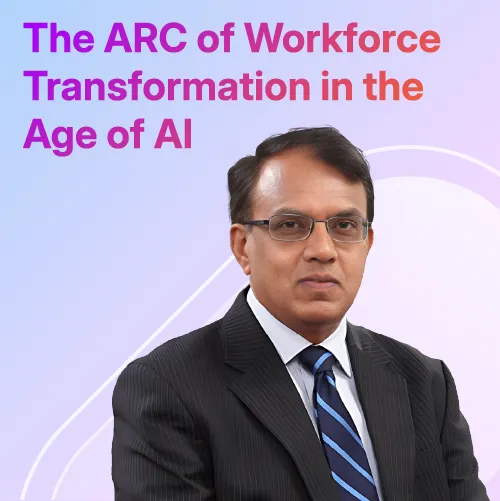
The age of artificial intelligence (AI) is not a single shock to the system, but a continuing ARC of workforce change: Automation of tasks, Redesign of jobs, and Creation of new roles. Viewed through this lens,
the AI conversation shifts away from anxiety about job loss and toward concrete decisions about how work, skills and careers will evolve.
Across industries, the more useful question is not whether a job will survive, but how it will change: which tasks will be automated, which roles will be augmented and what entirely new forms of work will emerge. Depending on the role, AI may affect 5% of daily tasks or as much as 95%, with very different implications in each case. The balance across automation, redesign and creation will vary accordingly, and each phase of this ARC brings distinct risks, opportunities and responsibilities for workers, employers, educators and policymakers alike.
Automation is where AI’s impact is most visible, delivering productivity gains by helping people do more, at higher quality, with less friction. In practice, this means automating discrete, information-rich tasks such as summarizing documents, classifying data, drafting content, handling routine queries or optimizing schedules, while amplifying human judgment, creativity and relationships rather than eliminating them.
Crucially, automation operates at the level of tasks, not job titles. Within any role, some activities map closely to what AI systems can handle, while others remain deeply human, including complex negotiation, in-person care and creative problem framing. Routine cognitive work across clerical, paralegal, customer service, basic coding and standardized reporting functions is especially exposed, while many physical and service roles resist full automation because they rely on embodied skills, social nuance or unstructured environments.
This does not mean job displacement is unreal, but it is rarely total or instantaneous. AI tends to unbundle jobs into tasks that are automated, augmented or reassigned, changing staffing needs and skill requirements over time. Real productivity gains depend less on deploying tools and more on giving workers direct access to them, along with structured training. Many AI initiatives disappoint not for technical reasons, but because workforce skills are left behind.
As tasks are automated, organizations must rethink how work is structured, triggering redesigns of roles, workflows and career paths. The core principle is simple: routine tasks shift to AI, while human effort concentrates on judgment, creativity, coordination and relationship-building. Redesign is not optional. Without it, automation merely accelerates existing inefficiencies.
Across sectors from warehousing to ride-hailing, AI systems increasingly coordinate work, allocate tasks and evaluate performance, reshaping power dynamics between front-line workers and those who design and manage these systems. In professional fields such as law, finance, marketing and research, AI is already embedded in daily work, shifting human roles toward oversight, sense-making and client engagement.
A similar shift is underway in software development. Entry-level programmers are evolving into AI-augmented engineers, as routine coding, debugging and documentation shrink and responsibilities for system design, integration and code review grow.
Enabling these changes requires a parallel redesign of skilling and upskilling models, moving beyond content-only learning toward cohort-based, blended programs with hands-on practice and credible assessments of real capability.
Every major technological wave has created new roles, and AI is no exception. What is different this time is the speed of change and the pressure on organizations to adapt quickly. The lack of clear guardrails, persistent bias risks and the possibility of AI hallucinations have already made the case for new roles in AI governance, risk management and ethics.
Hybrid roles that combine domain expertise with AI fluency, such as AI-assisted social workers, nurse coordinators using predictive tools or educators designing AI-informed learning pathways, are becoming more important than narrowly technical roles alone. In IT, while data scientists and AI engineers are now well established, roles like forward deployment engineers are emerging as enterprises move AI from pilot projects into production.
Importantly, many of these roles can be filled internally by identifying adjacent skills and creating targeted upskilling pathways, offering workers greater relevance and upward mobility.
For leaders, educators and workers, ARC can serve as a practical checklist for workforce planning. For each role or process, the questions are straightforward:
Used this way, ARC becomes a shared language for workforce planning, change management and policy design.
Across the ARC, workforce reskilling is less about mastering a single tool and more about navigating evolving combinations of human and machine strengths. Following is a blueprint to guide learning leaders in the right direction.
Effective reskilling starts with a task-level view of work. Which tasks in a role are likely to be automated, augmented or newly created? Answering these questions makes it possible to:
AI literacy should become a baseline capability, similar to basic computer literacy in earlier digital waves. This includes:
Reskilling cannot reduce workers to low-level operators of opaque systems. The most robust roles will blend:
These combinations are harder to automate and more valuable in organizations navigating complex, AI-enabled environments.
Traditionally, investments in learning have been justified by effort-based metrics: number of people trained, hours of content consumed or certificates earned. While effort matters, impact will be measured by outcomes: having the right talent at the right time and reducing the total cost of human capital. Learning has to be continuous, with demonstrable skills, not a one-time completion of an online course.
The age of AI does not come with a single script for the future of work. What emerges will depend on how societies manage automation, redesign jobs and workflows, and create new capabilities. Most workers will see their job content change before their job category disappears.
By using the ARC framework, learning leaders can more clearly see where interventions are needed and how workers can be supported through transition. With intentional reskilling, inclusive governance, and a commitment to directing AI toward human flourishing, the ARC of workforce transformation can bend toward greater opportunity rather than greater insecurity. The central question of the AI era is not whether work will change, but who benefits from that change.
For more details, read the full article here.

Share







.webp)
.webp)
.webp)
.webp)
.webp)

.webp)
.webp)

.webp)
.webp)

.webp)






%25201-03.webp)

-04.webp)

-05%25202.png)












.png)